

A Brief Look at Insight Dialogue
This is the second post for this month’s focus on Insight Dialogue.
Whether on retreat or in a weekly group, Insight Dialogue unfolds as a simple practice: after a period of silent seated meditation, participants are asked to sit—together, with their eyes open—usually but not always in pairs. First in silence, and then while alternating listening and speaking, they are invited to observe each present moment experience.
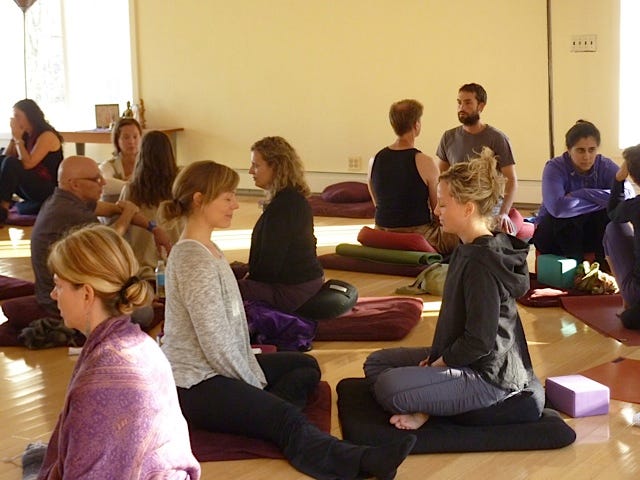
A key aspect of the practice is a set of six guidelines that help sustain meditative qualities during relational interaction, even as conceptual or emotional excitement arises. These are the Insight Dialogue Guidelines: Pause, Relax, Open, Attune to Emergence, Listen Deeply, and Speak the Truth.
Insight Dialogue cannot be fully understood by words alone. Each guideline points to specific qualities of awareness.
As with traditional meditation practice instructions, the guidelines are just that—guidelines, as Insight Dialogue cannot be fully understood by words alone. Each guideline points to specific qualities of awareness. For example, “pause” points us toward mindfulness, “relax” points us toward tranquility, and so on. With each step, practice develops, and more refined aspects of meditative skill are revealed. As this occurs, the guidelines are gradually experienced as facets of an integrated wakefulness: compassionate, serene, vital, and related.
The natural inquiry of this meditation practice is usually framed by a penetrating wisdom teaching. The teacher offers a contemplation topic that gives the meditators something to speak about. The contemplation brings to the practice inspiration, challenge, and transformative power of root wisdom.
A compelling and experience-based inquiry invites greater focus as it aims the dialogue towards potent reflections on present experience. For example, meditators may observe their responses as they consider the impermanence of all experiences, the power of generosity, or the inevitability of death. They speak from this present-moment experience and listen deeply, supported by meditative qualities. Pauses are ample, and at times the teacher returns the group to silence to deepen mindfulness and tranquility.
We begin to see aspects of mind and life that cannot be seen alone.
As the practice ripens, we may find that we can experience a clear, stable awareness even as we move in and out of habitual and conditioned ways of thinking. Meditating together nurtures qualities of relationship that are conducive to the arising of wise understanding. Gradually, meditators become aware of the Insight Dialogue’s gift of co-regulation, mutual support for a most natural compassion, the calming and safety of being met with receptivity and genuineness; they begin to see aspects of mind and life that cannot be seen alone. Classic teachings on doubt, suffering, compassion, and spiritual friendship can find their way far into our hearts. Wisdom teachings brought into this relational cauldron come alive as challenge and possibility.
Because Insight Dialogue unfolds with other human beings, the meditative qualities that can be so powerful for nurturing insight in the practice setting naturally follow us into our lives of daily human interaction and social contact. Along with wisdom and liberation from psychological constriction, then, Insight Dialogue nurtures relational ease and maturity. It also sheds light on the relational nature of human experience, the path to freedom, and the Dhamma as a whole.
Practice with the guideline Pause
I invite you to slow down, to find the present moment, and explore Pause – here and now. You don’t need another person’s presence to Pause from habitual thoughts and reactions. Pause from reading and from thinking for a moment and notice the body. What is the posture of the body now? What is the shape and form of the body? You can ask, “How am I feeling right now?” You can notice any sensations or tensions. At this first level, the Pause is a definite gap in our activities; it takes time. Notice the sense of letting go of whatever you were doing or thinking. Pause.
---
When you Pause, notice how it feels to release clinging. In the very moment you step into mindfulness, you are stepping out of identification with all of your reactions. If the mind is still buzzing with emotions, don’t worry. This is natural. For your entire life the mind has been pushing forward into what’s next, and that won’t stop right away. But notice the quality of knowing the thoughts and emotions without identifying with them. The emotions are interrupted, and something fresh can now happen.
As your practice ripens, this Pause becomes essentially continuous. We feel steady and awake. The mind is clinging less and less. Even a drop into habit-mind is just a temporary excursion. Notice how the mind takes up its old burdens but then drops them again. So the mindfulness of the Pause goes right through speaking, listening, silence and thought. You may notice a kind of vibrating silence when you Pause. Even when someone is speaking, or a thought arises, that silence is there. Stepping out of the mind storms that usually occupy us, we find this wakeful silence is available at any time: in retreat, in life; it is all the same.
The main text was written in 2019 and previously unpublished. The “Practice with the guideline Pause” is excerpted from page 109 and 116 of Insight Dialogue: The Interpersonal Path to Freedom by Gregory Kramer (Shambhala Publications, 2007).